Note
Go to the end to download the full example code.
SQLite-backed approval workflow
Real-world state machines often need to survive process restarts. This example shows how to persist a StateChart configuration to a relational database, using the same property getter/setter pattern that ORMs like Django and SQLAlchemy use under the hood.
We build a document approval workflow where each document must pass both a legal and a technical review (parallel tracks) before it can be approved. If any reviewer rejects, the document is rejected immediately — the entire parallel state is exited at once.
The example also compares two configuration update strategies controlled by
atomic_configuration_update:
Incremental (
False,StateChartdefault, SCXML-spec compliant): the configuration is updated state-by-state as the engine enters and exits states during a microstep.Atomic (
True,StateMachinedefault): the full configuration is computed first and written in a single operation — fewer database writes per transition.
import sqlite3

from statemachine.orderedset import OrderedSet

from statemachine import State
from statemachine import StateChart
Database abstraction
WorkflowDB manages two tables:
documents — each row is a domain entity with
id,title,author, and astatecolumn that holds the serialized state chart configuration.state_history — an append-only log of every state mutation, useful for auditing, debugging, or building a timeline view.
The state is serialized as a comma-separated string. NULL means
“no state yet” (the state chart will enter its initial state on creation).
class WorkflowDB:
    """SQLite persistence layer for document workflows."""

    def __init__(self):
        self.conn = sqlite3.connect(":memory:")
        self.conn.execute(
            "CREATE TABLE documents ("
            "  id INTEGER PRIMARY KEY AUTOINCREMENT,"
            "  title TEXT NOT NULL,"
            "  author TEXT NOT NULL,"
            "  state TEXT"
            ")"
        )
        self.conn.execute(
            "CREATE TABLE state_history ("
            "  id INTEGER PRIMARY KEY AUTOINCREMENT,"
            "  document_id INTEGER NOT NULL REFERENCES documents(id),"
            "  old_state TEXT,"
            "  new_state TEXT"
            ")"
        )
        self.conn.commit()

    def insert_document(self, title, author):
        """Insert a new document and return its id."""
        cur = self.conn.execute(
            "INSERT INTO documents (title, author) VALUES (?, ?)", (title, author)
        )
        self.conn.commit()
        return cur.lastrowid

    def find_document(self, doc_id):
        """Return ``(title, author)`` for the given document."""
        return self.conn.execute(
            "SELECT title, author FROM documents WHERE id = ?", (doc_id,)
        ).fetchone()

    def get_state(self, doc_id):
        """Read state from the DB and deserialize."""
        raw = self.conn.execute("SELECT state FROM documents WHERE id = ?", (doc_id,)).fetchone()[
            0
        ]
        if raw is None:
            return None
        parts = raw.split(",")
        return parts[0] if len(parts) == 1 else OrderedSet(parts)

    def set_state(self, doc_id, value):
        """Serialize state, persist it, and record the mutation in history."""
        old_raw = self.conn.execute(
            "SELECT state FROM documents WHERE id = ?", (doc_id,)
        ).fetchone()[0]

        if value is None:
            new_raw = None
        elif isinstance(value, OrderedSet):
            new_raw = ",".join(str(v) for v in value)
        else:
            new_raw = str(value)

        self.conn.execute("UPDATE documents SET state = ? WHERE id = ?", (new_raw, doc_id))
        self.conn.execute(
            "INSERT INTO state_history (document_id, old_state, new_state) VALUES (?, ?, ?)",
            (doc_id, old_raw, new_raw),
        )
        self.conn.commit()

    def all_documents(self):
        """Return all rows from the documents table."""
        return self.conn.execute(
            "SELECT id, title, author, state FROM documents ORDER BY id"
        ).fetchall()

    def history_for(self, doc_id):
        """Return the state mutation history for a specific document."""
        return self.conn.execute(
            "SELECT id, old_state, new_state FROM state_history WHERE document_id = ? ORDER BY id",
            (doc_id,),
        ).fetchall()

    def mutation_count(self):
        """Return the total number of state mutations recorded."""
        return self.conn.execute("SELECT COUNT(*) FROM state_history").fetchone()[0]

    def close(self):
        self.conn.close()
Domain model
Document is a domain entity. Its state property reads from and writes
to the database on every access — each getter call returns a freshly
deserialized object. This is exactly how Django model fields and
SQLAlchemy column properties work: the ORM never hands you the same Python
object twice.
Each Document owns a workflow instance, following the same pattern as
MachineMixin: the model holds a reference to
its state machine. The workflow class is injected at creation time, keeping
the model decoupled from any specific chart definition.
class Document:
    """A document that needs approval."""

    def __init__(self, store, doc_id, title, author):
        self.store = store
        self.id = doc_id
        self.title = title
        self.author = author
        self.workflow: "ApprovalWorkflow | None" = None

    @classmethod
    def create(cls, store, workflow_cls, title, author):
        """Insert a new document into the DB and start its workflow."""
        doc_id = store.insert_document(title, author)
        doc = cls(store, doc_id, title, author)
        doc.workflow = workflow_cls(model=doc)
        return doc

    @classmethod
    def load(cls, store, workflow_cls, doc_id):
        """Restore a document and its workflow from the DB."""
        title, author = store.find_document(doc_id)
        doc = cls(store, doc_id, title, author)
        doc.workflow = workflow_cls(model=doc)
        return doc

    @property
    def state(self):
        return self.store.get_state(self.id)

    @state.setter
    def state(self, value):
        self.store.set_state(self.id, value)

    def __repr__(self):
        config = list(self.workflow.configuration_values) if self.workflow else "?"
        return f"Document(#{self.id} {self.title!r} by {self.author}, state={config})"
Approval workflow
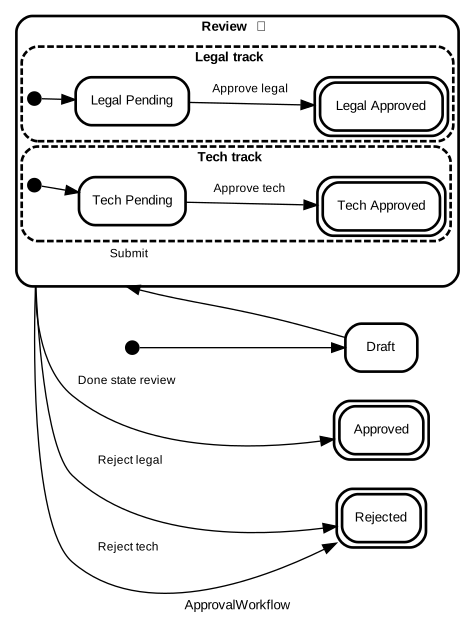
A document starts as a draft. When submitted, it enters a parallel review state: legal and technical tracks run independently.
Both approve →
done.state.reviewfires → approvedAny reviewer rejects → exits the entire parallel state → rejected
class ApprovalWorkflow(StateChart):
    """Document approval with parallel legal and technical review tracks."""

    draft = State("Draft", initial=True)

    class review(State.Parallel):
        class legal_track(State.Compound):
            legal_pending = State("Legal Pending", initial=True)
            legal_approved = State("Legal Approved", final=True)

            approve_legal = legal_pending.to(legal_approved)

        class tech_track(State.Compound):
            tech_pending = State("Tech Pending", initial=True)
            tech_approved = State("Tech Approved", final=True)

            approve_tech = tech_pending.to(tech_approved)

    submit = draft.to(review)

    approved = State("Approved", final=True)
    rejected = State("Rejected", final=True)

    done_state_review = review.to(approved)
    reject_legal = review.to(rejected)
    reject_tech = review.to(rejected)
Here is the workflow diagram — note the two parallel regions inside
review and the reject_legal / reject_tech transitions that exit
the entire parallel state at once.
sm = ApprovalWorkflow()
sm
Display helper
def print_table(headers, rows):
    """Print a simple formatted table."""
    widths = [len(h) for h in headers]
    for row in rows:
        for i, val in enumerate(row):
            widths[i] = max(widths[i], len(str(val) if val is not None else "NULL"))
    fmt = "  ".join(f"{{:<{w}}}" for w in widths)
    print(fmt.format(*headers))
    print("  ".join("-" * w for w in widths))
    for row in rows:
        print(fmt.format(*(str(v) if v is not None else "NULL" for v in row)))
Incremental configuration updates
StateChart defaults to atomic_configuration_update=False, following
the SCXML specification: the configuration is modified state-by-state as the
engine enters and exits states during each microstep (configuration.add()
and configuration.discard() in the W3C algorithm).
Each add() or discard() call triggers the model’s state property
setter, which writes to the database. This means you’ll see one DB write
per state entered or exited — fine for correctness, but chatty for
persistence layers.
db_inc = WorkflowDB()

alice = Document.create(db_inc, ApprovalWorkflow, "RFC-001: API Redesign", "Alice")
bob = Document.create(db_inc, ApprovalWorkflow, "RFC-002: DB Migration", "Bob")

print(f"Created: {alice}")
print(f"Created: {bob}")

assert alice.state == "draft"
assert bob.state == "draft"
Created: Document(#1 'RFC-001: API Redesign' by Alice, state=['draft'])
Created: Document(#2 'RFC-002: DB Migration' by Bob, state=['draft'])
Alice’s document goes through full approval.
alice.workflow.send("submit")
print(f"After submit:   {alice}")

alice.workflow.send("approve_legal")
print(f"Legal approved: {alice}")
assert "legal_approved" in alice.workflow.configuration_values
assert "tech_pending" in alice.workflow.configuration_values

alice.workflow.send("approve_tech")
print(f"Fully approved: {alice}")
After submit:   Document(#1 'RFC-001: API Redesign' by Alice, state=['review', 'legal_track', 'legal_pending', 'tech_track', 'tech_pending'])
Legal approved: Document(#1 'RFC-001: API Redesign' by Alice, state=['review', 'legal_track', 'tech_track', 'tech_pending', 'legal_approved'])
Fully approved: Document(#1 'RFC-001: API Redesign' by Alice, state=['approved'])
When both tracks reach their final state, done.state.review fires
automatically and the workflow transitions to approved.
assert alice.workflow.approved.is_active
assert alice.state == "approved"
Bob’s document is rejected by the legal team. The reject_legal
event transitions out of the review parallel state, exiting all child
states at once — even though technical review hasn’t started yet.
bob.workflow.send("submit")
bob.workflow.send("reject_legal")
print(f"Rejected:       {bob}")
assert bob.workflow.rejected.is_active
assert bob.state == "rejected"
Rejected: Document(#2 'RFC-002: DB Migration' by Bob, state=['rejected'])
Documents table (incremental mode)
print()
print_table(["id", "title", "author", "state"], db_inc.all_documents())
id  title                  author  state
--  ---------------------  ------  --------
1   RFC-001: API Redesign  Alice   approved
2   RFC-002: DB Migration  Bob     rejected
State mutation history — Alice’s document
Every add() / discard() call during state entry or exit is a
separate DB write. The history reveals the step-by-step construction and
teardown of the parallel configuration:
draft → NULL → review → add legal_track → add
legal_pending → add tech_track → add tech_pending → …
print()
print_table(["#", "old_state", "new_state"], db_inc.history_for(alice.id))

inc_mutations = db_inc.mutation_count()
print(f"\nTotal mutations (incremental, 2 docs): {inc_mutations}")
#   old_state                                                   new_state
--  ----------------------------------------------------------  ----------------------------------------------------------
1   NULL                                                        draft
3   draft                                                       NULL
4   NULL                                                        review
5   review                                                      review,legal_track
6   review,legal_track                                          review,legal_track,legal_pending
7   review,legal_track,legal_pending                            review,legal_track,legal_pending,tech_track
8   review,legal_track,legal_pending,tech_track                 review,legal_track,legal_pending,tech_track,tech_pending
9   review,legal_track,legal_pending,tech_track,tech_pending    review,legal_track,tech_track,tech_pending
10  review,legal_track,tech_track,tech_pending                  review,legal_track,tech_track,tech_pending,legal_approved
11  review,legal_track,tech_track,tech_pending,legal_approved   review,legal_track,tech_track,legal_approved
12  review,legal_track,tech_track,legal_approved                review,legal_track,tech_track,legal_approved,tech_approved
13  review,legal_track,tech_track,legal_approved,tech_approved  review,legal_track,tech_track,legal_approved
14  review,legal_track,tech_track,legal_approved                review,legal_track,tech_track
15  review,legal_track,tech_track                               review,legal_track
16  review,legal_track                                          review
17  review                                                      NULL
18  NULL                                                        approved

Total mutations (incremental, 2 docs): 30
Atomic configuration updates
Setting atomic_configuration_update=True changes the strategy: the
engine computes the full new configuration first, then writes it in a
single setattr call. This means one DB write per microstep instead
of one per state — a significant reduction for parallel charts.
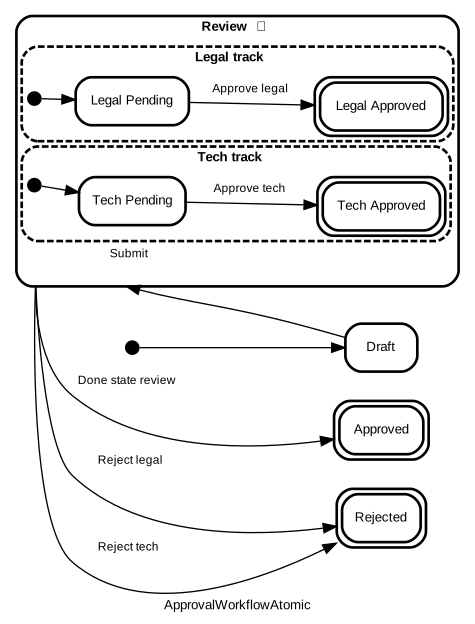
We can enable this with a one-line subclass:
class ApprovalWorkflowAtomic(ApprovalWorkflow):
    """Same workflow with atomic configuration updates."""

    atomic_configuration_update = True
Run the same scenario with atomic updates.
db_atom = WorkflowDB()

alice2 = Document.create(db_atom, ApprovalWorkflowAtomic, "RFC-001: API Redesign", "Alice")
bob2 = Document.create(db_atom, ApprovalWorkflowAtomic, "RFC-002: DB Migration", "Bob")

alice2.workflow.send("submit")
alice2.workflow.send("approve_legal")
alice2.workflow.send("approve_tech")
assert alice2.state == "approved"

bob2.workflow.send("submit")
bob2.workflow.send("reject_legal")
assert bob2.state == "rejected"

print(f"Alice: {alice2}")
print(f"Bob:   {bob2}")
Alice: Document(#1 'RFC-001: API Redesign' by Alice, state=['approved'])
Bob:   Document(#2 'RFC-002: DB Migration' by Bob, state=['rejected'])
State mutation history — Alice’s document (atomic mode)
Each microstep now produces one DB write with the full configuration. No intermediate states are visible.
print()
print_table(["#", "old_state", "new_state"], db_atom.history_for(alice2.id))

atom_mutations = db_atom.mutation_count()
print(f"\nTotal mutations (atomic, 2 docs): {atom_mutations}")
#  old_state                                                   new_state
-  ----------------------------------------------------------  ----------------------------------------------------------
1  NULL                                                        draft
3  draft                                                       review,legal_track,legal_pending,tech_track,tech_pending
4  review,legal_track,legal_pending,tech_track,tech_pending    review,legal_track,tech_track,tech_pending,legal_approved
5  review,legal_track,tech_track,tech_pending,legal_approved   review,legal_track,tech_track,legal_approved,tech_approved
6  review,legal_track,tech_track,legal_approved,tech_approved  approved

Total mutations (atomic, 2 docs): 8
Comparison
Both modes produce identical final states, but atomic mode generates significantly fewer database writes — especially with parallel states where many children are entered and exited simultaneously.
print(f"\nIncremental: {inc_mutations} mutations")
print(f"Atomic:      {atom_mutations} mutations")
assert atom_mutations < inc_mutations
Incremental: 30 mutations
Atomic:      8 mutations
State restoration from the database
The real test of persistence: delete the Python objects and recreate them from the database. The state chart should resume exactly where it left off, preserving even parallel configurations.
alice_id = alice.id
alice_config = list(alice.workflow.configuration_values)
del alice

alice_restored = Document.load(db_inc, ApprovalWorkflow, alice_id)
print(f"Restored: {alice_restored}")
assert list(alice_restored.workflow.configuration_values) == alice_config
Restored: Document(#1 'RFC-001: API Redesign' by Alice, state=['approved'])
Bob’s rejection is also preserved — no state is lost.
bob_id = bob.id
del bob

bob_restored = Document.load(db_inc, ApprovalWorkflow, bob_id)
print(f"Restored: {bob_restored}")
assert bob_restored.state == "rejected"
Restored: Document(#2 'RFC-002: DB Migration' by Bob, state=['rejected'])
Final documents table
print()
print_table(["id", "title", "author", "state"], db_inc.all_documents())
id  title                  author  state
--  ---------------------  ------  --------
1   RFC-001: API Redesign  Alice   approved
2   RFC-002: DB Migration  Bob     rejected
Cleanup.
db_inc.close()
db_atom.close()