Transitions
See also
New to statecharts? See Core concepts for an overview of how states, transitions, events, and actions fit together.
A transition describes a valid state change: it connects a source state to a target state and is triggered by an event. Transitions can carry Actions (side-effects) and conditions that control whether the transition fires.
Declaring transitions
Link states using source.to(target) and assign the result to a class
attribute — the attribute name becomes the event:
>>> from statemachine import State, StateChart

>>> class OrderSM(StateChart):
...     pending = State(initial=True)
...     confirmed = State(final=True)
...
...     confirm = pending.to(confirmed)

>>> sm = OrderSM()
>>> sm.send("confirm")
>>> "confirmed" in sm.configuration_values
True
Transition parameters
Parameter |
Description |
|---|---|
|
Action callback(s) to run during the transition. See Transition actions. |
|
Callback(s) to run before exit/on/enter. |
|
Callback(s) to run after the transition completes. |
|
Guard condition(s). See Conditions. |
|
Negative guard — transition fires when this returns |
|
Validation callback(s) that raise on failure. |
|
Override the event for this transition. See The event parameter on transitions. |
|
If |
Combining transitions with |
The | operator merges transitions under a single event. Each transition
is evaluated in declaration order — the first whose conditions are met wins:
>>> class TrafficLight(StateChart):
...     green = State(initial=True)
...     yellow = State()
...     red = State()
...
...     cycle = green.to(yellow) | yellow.to(red) | red.to(green)

>>> sm = TrafficLight()
>>> sm.send("cycle")
>>> "yellow" in sm.configuration_values
True
Combine | with guards to route the same event to different targets:
>>> class OrderReview(StateChart):
...     pending = State(initial=True)
...     approved = State(final=True)
...     rejected = State(final=True)
...
...     review = (
...         pending.to(approved, cond="is_valid")
...         | pending.to(rejected)
...     )
...
...     def is_valid(self, score: int = 0):
...         return score >= 70

>>> sm = OrderReview()
>>> sm.send("review", score=50)
>>> "rejected" in sm.configuration_values
True

>>> sm = OrderReview()
>>> sm.send("review", score=85)
>>> "approved" in sm.configuration_values
True
The first transition whose guard passes wins. When score < 70, is_valid
returns False, so the second transition (no guard — always matches) fires.
from_() and from_.any()
target.from_(source) declares the same transition from the target’s
perspective — useful when multiple sources converge on one target:
>>> class OrderSM(StateChart):
...     pending = State(initial=True)
...     processing = State()
...     shipped = State(final=True)
...
...     process = pending.to(processing)
...     ship = shipped.from_(pending, processing)
target.from_.any() creates a transition from every non-final state —
useful for global events like “cancel” that should be reachable from anywhere:
>>> class OrderWorkflow(StateChart):
...     pending = State(initial=True)
...     processing = State()
...     done = State()
...     completed = State(final=True)
...     cancelled = State(final=True)
...
...     process = pending.to(processing)
...     complete = processing.to(done)
...     finish = done.to(completed)
...     cancel = cancelled.from_.any()

>>> sm = OrderWorkflow()
>>> sm.send("cancel")
>>> "cancelled" in sm.configuration_values
True
With compound states, there is another way to model
the same workflow: group the cancellable states under a compound parent, and
define a single transition out of it. The cancel event exits the compound
regardless of which child is active:
>>> class OrderWorkflowCompound(StateChart):
...     class active(State.Compound):
...         pending = State(initial=True)
...         processing = State()
...         done = State(final=True)
...
...         process = pending.to(processing)
...         complete = processing.to(done)
...     completed = State(final=True)
...     cancelled = State(final=True)
...     done_state_active = active.to(completed)
...     cancel = active.to(cancelled)

>>> sm = OrderWorkflowCompound()
>>> sm.send("process")
>>> sm.send("cancel")
>>> "cancelled" in sm.configuration_values
True
Compare the diagrams — both model the same behavior, but the compound version makes the “cancellable” grouping explicit in the hierarchy:
>>> getfixture("requires_dot_installed")
>>> OrderWorkflow()._graph().write_png("docs/images/transition_from_any.png")
>>> OrderWorkflowCompound()._graph().write_png("docs/images/transition_compound_cancel.png")
|
Compound |
|---|---|
|
|
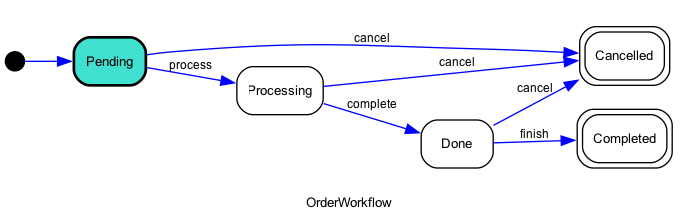
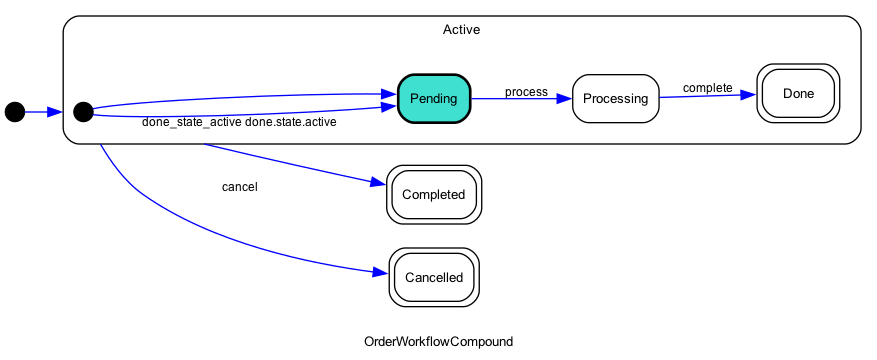
The compound approach scales better as you add more states — no need to
remember to include each new state in a from_() list.
Self-transitions and internal transitions
A self-transition goes from a state back to itself. It exits and re-enters the state, running all exit and entry actions:
>>> class RetryOrder(StateChart):
...     processing = State(initial=True)
...     done = State(final=True)
...
...     retry = processing.to.itself(on="do_retry")
...     finish = processing.to(done)
...
...     attempts: int = 0
...
...     def do_retry(self):
...         self.attempts += 1

>>> sm = RetryOrder()
>>> sm.send("retry")
>>> sm.send("retry")
>>> sm.attempts
2
An internal transition stays in the same state without running exit
or entry actions — only the on callback executes. Use internal=True:
>>> class OrderCart(StateChart):
...     shopping = State(initial=True)
...     checkout = State(final=True)
...
...     add_item = shopping.to.itself(internal=True, on="do_add_item")
...     pay = shopping.to(checkout)
...
...     total: float = 0
...
...     def do_add_item(self, price: float = 0):
...         self.total += price

>>> sm = OrderCart()
>>> sm.send("add_item", price=9.99)
>>> sm.send("add_item", price=4.50)
>>> sm.total
14.49
The key difference: self-transitions fire exit/enter callbacks (useful when entering a state has side-effects like resetting a timer), while internal transitions skip them (useful for pure data updates that shouldn’t re-trigger entry logic).
See also
The enable_self_transition_entries flag in Behaviour controls whether
self-transitions run exit/enter actions. StateChart defaults to True (SCXML
semantics); StateMachine defaults to False (legacy behavior).
Eventless (automatic) transitions
Added in version 3.0.0.
Eventless transitions have no event trigger — they fire automatically when
their guard condition evaluates to True. If no guard is specified, they
fire immediately (unconditional). Declare them as bare statements, without
assigning to a variable:
>>> from statemachine import State, StateChart

>>> class AutoEscalation(StateChart):
...     normal = State(initial=True)
...     escalated = State(final=True)
...     normal.to(escalated, cond="should_escalate")
...     report = normal.to.itself(internal=True, on="add_report")
...     report_count = 0
...     def should_escalate(self):
...         return self.report_count >= 3
...     def add_report(self):
...         self.report_count += 1

>>> sm = AutoEscalation()
>>> sm.send("report")
>>> sm.send("report")
>>> "normal" in sm.configuration_values
True

>>> sm.send("report")
>>> "escalated" in sm.configuration_values
True
The eventless transition fires automatically after the third report pushes
report_count past the threshold.
See also
See Chaining transitions for chains, compound interactions, and In()
guards.
Cross-boundary transitions
Added in version 3.0.0.
In statecharts, transitions can cross compound state boundaries — going from a state inside one compound to a state outside, or into a different compound. The engine automatically determines which states to exit and enter by computing the transition domain: the smallest compound ancestor that contains both the source and all target states.
>>> from statemachine import State, StateChart

>>> class OrderFulfillment(StateChart):
...     class picking(State.Compound):
...         locating = State(initial=True)
...         packing = State()
...         locate = locating.to(packing)
...     class shipping(State.Compound):
...         labeling = State(initial=True)
...         dispatched = State(final=True)
...         dispatch = labeling.to(dispatched)
...     ship = picking.to(shipping)

>>> sm = OrderFulfillment()
>>> set(sm.configuration_values) == {"picking", "locating"}
True

>>> sm.send("ship")
>>> set(sm.configuration_values) == {"shipping", "labeling"}
True
When ship fires, the engine:
Computes the transition domain (the root, since
pickingandshippingare siblings)Exits
locatingandpicking(running their exit actions)Enters
shippingand its initial childlabeling(running their entry actions)
Transition priority in compound states
Added in version 3.0.0.
When an event could match transitions at multiple levels of the state hierarchy, transitions from descendant states take priority over transitions from ancestor states. This follows the SCXML specification: the most specific (deepest) matching transition wins.
>>> from statemachine import State, StateChart

>>> class OrderProcessing(StateChart):
...     log = []
...     class fulfillment(State.Compound):
...         class picking(State.Compound):
...             s1 = State(initial=True)
...             s2 = State(final=True)
...             go = s1.to(s2, on="log_picking")
...         assert isinstance(picking, State)
...         packed = State(final=True)
...         done_state_picking = picking.to(packed)
...     shipped = State(final=True)
...     done_state_fulfillment = fulfillment.to(shipped)
...     def log_picking(self):
...         self.log.append("picking handled it")

>>> sm = OrderProcessing()
>>> sm.send("go")
>>> sm.log
['picking handled it']
If two transitions at the same level would exit overlapping states (a conflict), the one declared first wins.